Reusable Flight Infrastructure for Orbital and Defense Program Derisking
EXOS Aerospace is an FAA-licensed reusable suborbital launch operator providing wet-leased flight test infrastructure for orbital vehicle development, advanced space technologies, defense applications, and responsive flight test campaigns. Our reusable launch platforms provide repeatable access to suborbital flight environments, enabling teams to validate avionics, guidance and navigation systems, flight controls, reentry architectures, and other mission-critical subsystems before committing to higher-cost full-scale programs.
EXOS is also under contract with the U.S. Department of Defense to develop the flight vehicle for RDRE engine flight demonstration. This work reflects the company’s role in supporting advanced propulsion flight testing where repeatability, speed, and practical execution matter.
Orbital and defense flight programs carry significant technical and reputational risk. Avionics, GNC, landing algorithms, reentry systems, propulsion controls, and other critical technologies are often first flown on high-value vehicles where a single failure can cost time, funding, and program momentum. EXOS addresses this challenge by providing flight-proven reusable launch vehicles as operational test platforms. Customers can fly critical systems as hosted payloads aboard an already licensed and recoverable rocket, generating real flight data without placing a full orbital asset at risk.
Our integrated wet lease model reduces customer integration burden while accelerating campaign timelines. Following ascent to space and atmospheric reentry, flight simulations such as vertical landing control validation can be executed at altitude. Regardless of test outcome, the vehicle is recovered through our guided canopy system, enabling hardware retrieval, post-flight analysis, and rapid iteration.
In addition to reusable launch services, EXOS advances integrated Type V composite pressurized structures, fractional parts count architectures that support repeatable reuse, and LOX/methane propulsion systems with extensive in-flight relight heritage. Our focus is operational flight infrastructure designed to reduce program risk, support sustained testing, accelerate orbital readiness, and enable repeatable flight test campaigns relevant to hypersonic, defense, and RDRE-aligned development efforts.
Frequently Asked Questions
1. What is wet lease launch?
Wet lease launch is a service model in which EXOS provides and operates the reusable launch vehicle, reducing integration burden for the customer. Instead of owning or integrating a full launch system, government and commercial payload teams fly on an operational EXOS platform, accelerating timelines and lowering program risk.
2. How does EXOS support hypersonic and advanced defense flight testing?
Defense flight test programs are often constrained by limited access to repeatable flight opportunities. EXOS increases test cadence by providing reusable suborbital launch vehicles designed for repeatability, payload recovery, and rapid campaign iteration. Our operational model supports more frequent test opportunities and practical subsystem validation for programs where schedule, learning cycles, and operational flexibility matter.
3. What types of payloads can fly on EXOS vehicles?
EXOS supports a wide range of payloads requiring suborbital flight or microgravity exposure. This includes hypersonic sensors, avionics systems, guidance and control packages, thermal protection systems, reentry technologies, and other advanced aerospace hardware.
In addition, EXOS supports university research, biomedical and materials science experiments, educational payloads, technology demonstrations, and commercial microgravity investigations. Our reusable suborbital platforms provide brief but meaningful microgravity environments and controlled reentry conditions suitable for research, testing, and validation across government, academic, and commercial sectors.
4. What are Type V composite pressurized structures?
Type V composite pressurized structures are linerless composite tanks engineered for high-performance and cryogenic propulsion applications. When integrated with surrounding vehicle structure, Type V architectures can enable fractional parts count design approaches by reducing interface complexity and combining structural functions at the system level.
Through its ownership position in Scorpius Space Launch Company, EXOS expands industrial capability in advanced composite pressurized structures that support reusable launch vehicles and next-generation propulsion systems.
5. What does “fractional parts count” mean?
Fractional parts count architecture refers to reducing the number of structural components within a launch vehicle stage. Fewer parts reduce inspection points, simplify maintenance, strengthen supply chain resilience, and support repeatable reuse - critical factors in increasing flight cadence.
6. Is EXOS FAA licensed for launch operations?
Yes. EXOS is an FAA-licensed reusable suborbital launch operator, authorized to conduct commercial launch activities in the United States. Our flight operations are structured to support government and commercial customers requiring compliant and repeatable access to space environments.
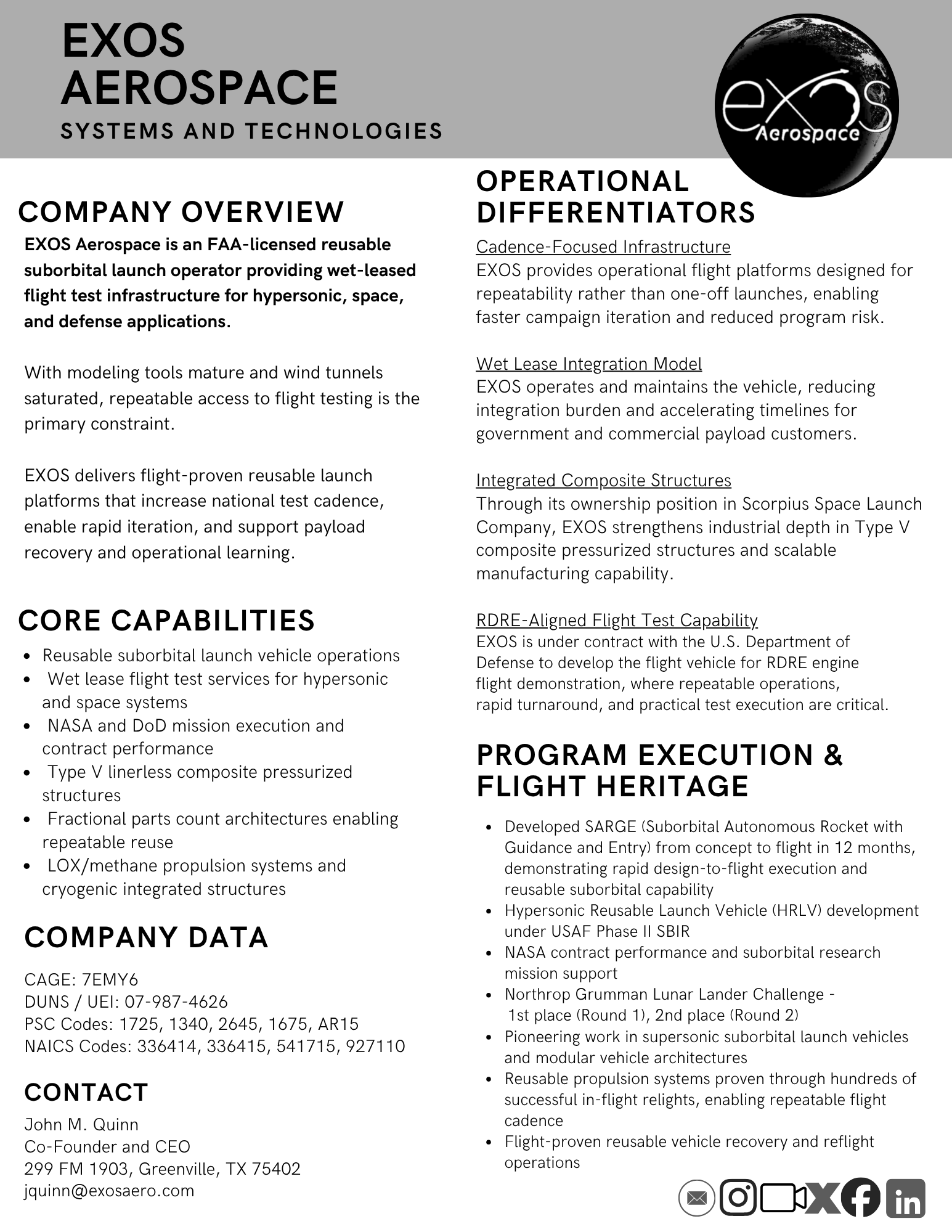
For procurement and program briefing purposes, a downloadable PDF version is available below.